
San Guillermo & El Leoncito: National Parks of San Juan
Five days between San Guillermo National Park and the skies of El Leoncito: a mountain refuge, searching for high-altitude wildlife and stargazing at CASLEO on a new moon night. March 5–9, 2027.
Northern San Juan is home to one of the most remote national parks in Argentina. San Guillermo is a high plateau surrounded by the Andes, reachable only by 4x4 and with time, which is why very few people visit it.
About 250 kilometers to the south, El Leoncito National Park protects a different resource: the sky. Its dry air, its many clear nights and the absence of artificial light are the reason the El Leoncito Astronomical Complex (CASLEO), one of the most important observatories in South America, operates there.
This trip combines both parks in five days, with a group of up to 9 travelers and a tour leader throughout. The walks are easy, and the night at CASLEO falls on the new moon of March 8, when the sky is at its darkest.
Day-by-day itinerary
Day 1 – Friday, March 5 – Cuesta del Viento and Rodeo See details
We meet at 1 p.m. at San Juan airport. If you arrive by bus, we pick you up at the bus terminal.
We head to the north of the province. Our first stop is the shrine of the Difunta Correa, one of the best-known sites of popular devotion in the country.
The road climbs into the Andean foothills to the Cuesta del Viento Reservoir, a body of water surrounded by mountains and known for its constant winds.
In the afternoon we reach Rodeo, a quiet mountain town, and stay in cabins at Complejo La Racha.
Day 2 – Saturday, March 6 – Into San Guillermo National Park See details
After breakfast we head north in 4x4 vehicles with a guide. The road turns to gravel and the landscape opens into wide plains. We stop for lunch on the way.
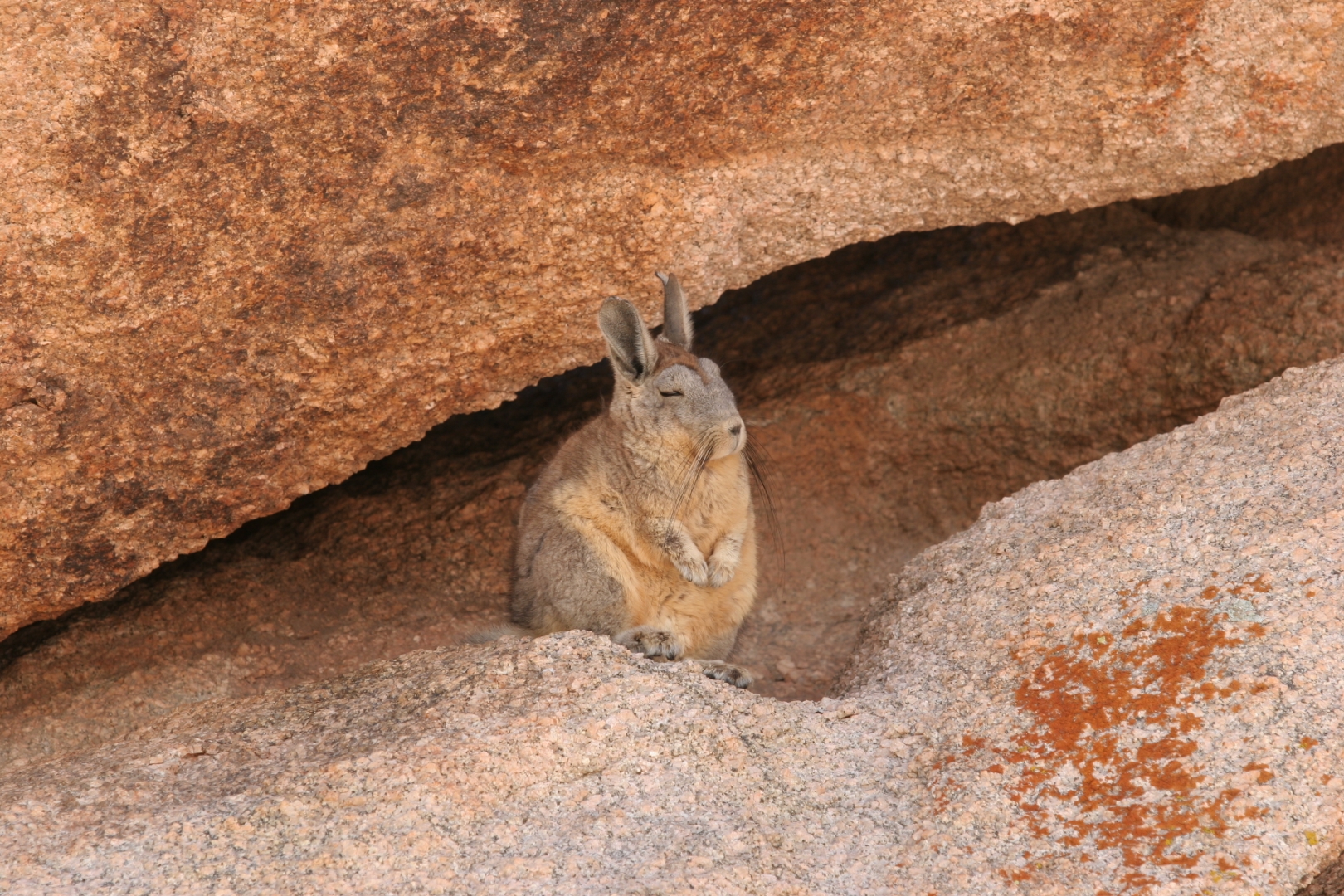
Once in the park we take our first walks along gentle trails, watching for high-altitude wildlife such as the mountain viscacha (Lagidium viscacia) and the vicuña, as well as tracks and signs. The park is also home to the puma, the fox and the condor; since this is wild fauna, no sighting can be guaranteed.
We spend the night at the Agua del Godo mountain refuge, inside the park, with dinner included. Far from any town, the sky already hints at what we will see two nights later.
Day 3 – Sunday, March 7 – A day in San Guillermo See details
We have breakfast at the refuge and set out to explore other areas of the park. San Guillermo is the core zone of a Biosphere Reserve designated by UNESCO in 1980, one of the best-preserved high-altitude environments in the country.
We walk its trails to get to know this environment: the vegetation adapted to cold and wind, the signs left by wildlife and the way each species makes use of the plateau. We keep watching for mountain viscachas, vicuñas and Andean birds.
Distances and pace are set by the group, so everyone can enjoy the walk.
We have lunch at the refuge and in the afternoon return to Rodeo to rest at La Racha.
Day 4 – Monday, March 8 – Barreal, El Leoncito and CASLEO See details
After breakfast we travel south to Barreal, a drive of about 3 hours along the Andes through the Calingasta valley.
In the afternoon we visit the Pampa El Leoncito, a vast, smooth white plain at the foot of the range, and then tour El Leoncito National Park.
After dark we drive up to CASLEO for the astronomical observation. With a new moon and clear skies, the Milky Way, star clusters, nebulae and planets can be seen with a sharpness that is hard to find anywhere else.
Night in Barreal.
Day 5 – Tuesday, March 9 – Cerro Siete Colores and return See details
We have breakfast in Barreal and start the drive back to San Juan.
On the way we do a guided geotrek at Cerro Siete Colores: a short walk to understand the geology that paints the mountain in bands of different colors.
We arrive in San Juan city around 7:30 p.m., and the trip ends at the airport or the bus terminal.
Highlights
- A refuge inside the park. One night at the mountain refuge of San Guillermo National Park, with no other lodging nearby: the only way to explore it without rushing.
- Searching for high-altitude wildlife. Guided walks looking for mountain viscachas, vicuñas and Andean birds, in one of the best-preserved environments in the country.
- Stargazing at CASLEO on a new moon. On the night of March 8, with the darkest sky of the month, we observe the southern sky at one of the most important observatories on the continent.
- Andean landscapes. Cuesta del Viento Reservoir, Pampa El Leoncito and Cerro Siete Colores: three very different landscapes in a single province.
Accommodation
The two nights in Rodeo are in triple cabins at Complejo La Racha, with breakfast. The night inside the park is at the Agua del Godo refuge, with dinner, breakfast and lunch. The last night is in Barreal, with breakfast.

Included
- Transfers from and to San Juan airport or bus terminal.
- 2 nights at Complejo La Racha (Rodeo), in triple cabins, with breakfast.
- 1 night at the mountain refuge of San Guillermo NP with dinner, breakfast and lunch.
- Guided 4x4 excursion in San Guillermo NP.
- Visit to Cuesta del Viento Reservoir.
- Visit to Pampa El Leoncito and El Leoncito NP.
- Astronomical observation at CASLEO.
- 1 night in Barreal with breakfast.
- Geotrek at Cerro Siete Colores.
- Tour leader throughout the trip.
- Travel assistance.
Not included
- Flight or bus to San Juan.
- Sleeping bag (needed for the night at the refuge).
- Meals not mentioned.
Price and payment
Price per person: ARS 1,350,000 (Argentine pesos).
Contact us for payment options for international travelers.
The group is limited to 9 travelers, a size set by the vehicles and the park refuge. Write to us for more information or to book your spot.
Frequently asked questions
Do I need previous experience or a special fitness level?
No. The walks are easy, along gentle trails and at a relaxed pace. Part of the route is at high altitude, so please let us know about any health condition when you book.
How do I get to San Juan?
You can arrive by plane or by bus. We meet at 1 p.m. at San Juan airport; if you come by bus, we pick you up at the bus terminal.
What should I bring?
A sleeping bag for the night at the refuge and warm clothes: at altitude and during the night observation, temperatures drop sharply, even in March. Before the trip we send you recommendations for packing.
Will we see vicuñas and pumas?
San Guillermo is one of the best places in the country to look for high-altitude wildlife, but it is wild fauna and no sighting can be guaranteed. We go out looking for it with a guide, at the times and in the areas with the best chances.
How do I pay?
Contact us for payment options for international travelers.