
Trekking in San Juan: Arroyo Turquesa, El Leoncito and Stargazing in the Andes
San Juan has some of the most extraordinary landscapes in the Argentine Andes and very little mass tourism. This guide explains what to do, where to go and when to visit the San Juan cordillera.
Why San Juan and not Mendoza or Bariloche
The question makes sense: Mendoza and Bariloche are well-established mountain destinations with plenty of activities. What does San Juan offer that they don't?
Mainly, three things. The first is scale. The San Juan cordillera is part of one of the highest sections of the Argentine Andes, with peaks exceeding 6,000 meters along the borders with Catamarca and La Rioja. The landscapes have a breadth and aridity that can't be found in other Andean provinces — more volcanic, more desert-like, more extreme.
The second is the sky. The combination of altitude, dryness and absence of light pollution gives San Juan some of the clearest skies on the planet. El Leoncito National Park, in the Calingasta Valley, has over 300 clear nights per year and is home to CASLEO — one of Argentina's leading astronomical observatories.
The third is the absence of crowds. While Mendoza receives millions of tourists per year and Bariloche has peak seasons of very high demand, San Juan remains a destination that few Argentines — and even fewer international travelers — know in depth. The trails are uncrowded, the viewpoints are quiet and the nature experience is genuine.
Arroyo Turquesa: one of the most striking treks in the Argentine Andes
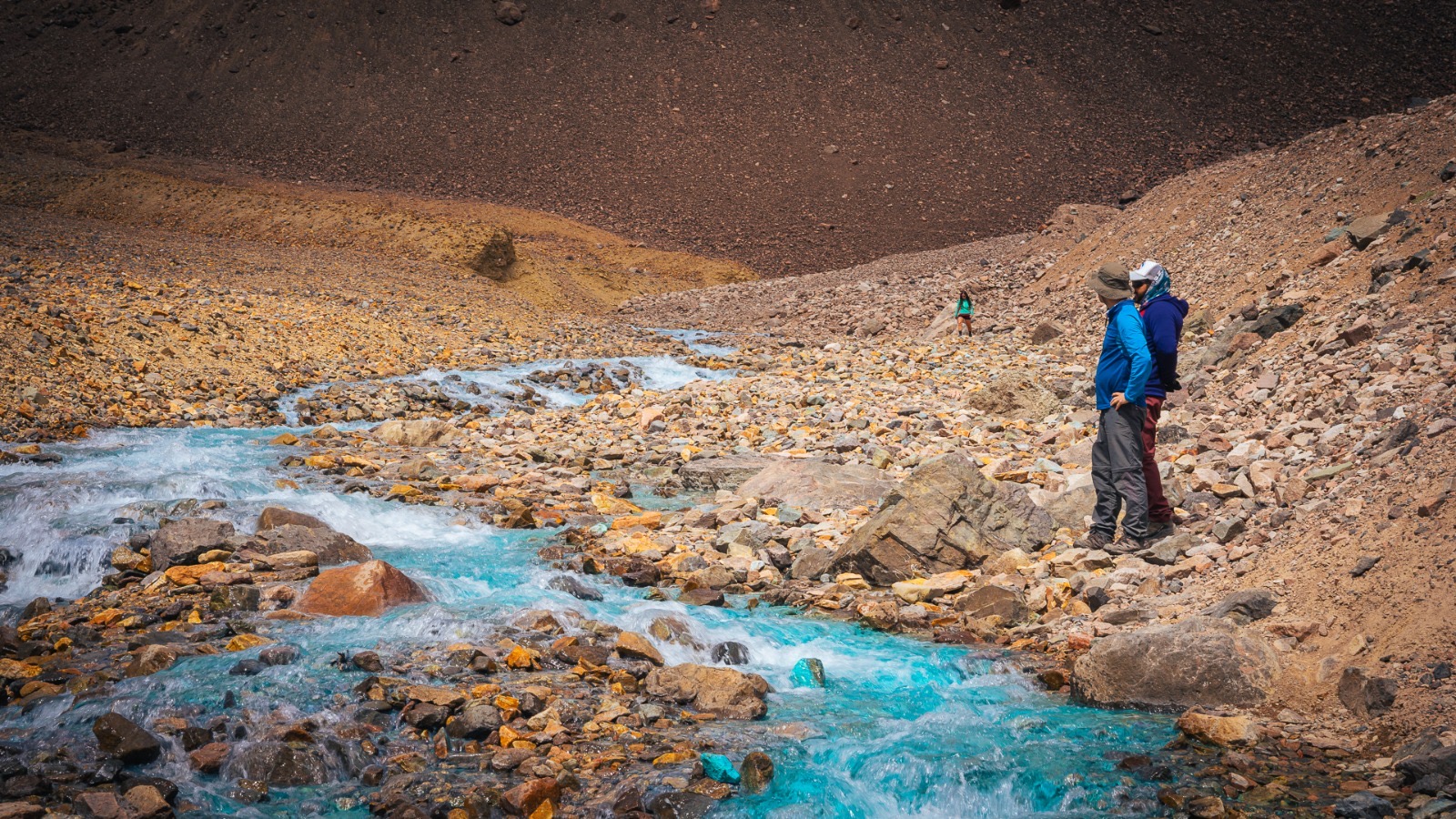
Arroyo Turquesa is located in the Cordillera del Límite in northwestern San Juan Province. The base for the trek is Barreal, a town in the Calingasta Valley from which travelers depart by 4x4 to the trailhead. The round-trip hike covers approximately 16 km and reaches altitudes above 4,000 meters above sea level.
The name is literal: the stream's water has an intense turquoise color produced by the minerals in the rock — mainly carbonates and silicates — which tint the water in a shade that contrasts dramatically with the brown and grey of the Andean mountain landscape.
At the end of the trail, views open onto the Caballito Glacier — one of the most accessible mountain glaciers in the San Juan cordillera. The contrast between the blue of the water, the white of the ice and the reddish-brown of the volcanic rock is one of the most photogenic landscapes in the Argentine Andes.
The trek requires no technical mountaineering experience, but does demand good general fitness and acclimatization to altitude. Above 3,500 meters the pace naturally slows and the landscape opens up.
Laguna Blanca: the starting point in the mountains
Laguna Blanca is a lake located at approximately 3,200 meters above sea level in the San Juan cordillera. From Barreal it is reachable by 4x4, and it serves as the natural starting point for the Arroyo Turquesa trek.
The lake takes its name from the whitish tone its water takes on in certain light conditions — though at dawn and sunset the reflection of the surrounding mountains turns it into a shifting mirror of colors that changes minute by minute.
Camping overnight at Laguna Blanca, without artificial light, under the San Juan cordillera sky, is an experience very few Argentine travelers have had. Nights are cold — temperatures can drop to 0°C or below even in spring — but the sky is exceptional for naked-eye astronomical observation.
El Leoncito National Park and stargazing
El Leoncito National Park is located in the Calingasta Valley, approximately 35 km south of Barreal. It protects a pre-Andean arid scrub ecosystem with wildlife including guanacos, grey foxes, pumas and a diversity of scrubland birds.
But the main reason El Leoncito is a reference destination is its sky. The combination of altitude (1,800 m), dryness, air-cleaning winds and absence of light pollution produces exceptional astronomical observation conditions. The park is home to CASLEO (El Leoncito Astronomical Complex), operated by CONICET and the National University of San Juan.
CASLEO runs guided night visits for the general public, where it is possible to observe planets, globular clusters, nebulae and galaxies through professional telescopes.
Pampa del Leoncito and land sailing
North of the park, the Pampa del Leoncito is a flat, arid plain that functions as a natural track for land sailing — wind-powered three-wheeled vehicles. The winds are constant and predictable, and the location has an international reputation among land sailing practitioners. No prior experience required.
Cerro de los Siete Colores and geological trekking
In the Barreal area, the Cerro de los Siete Colores is a geological formation whose layers display millions of years of Earth history. The colors — red, orange, yellow, green, white, grey and black — correspond to different rock types and the environmental conditions under which they formed. The walk is led by a specialist geologist who reads each layer as part of the story.
When is the best time to visit San Juan
The San Juan cordillera is accessible mainly in spring (September–November) and autumn (March–May). In winter, temperatures at altitude are very low and access routes can be snowbound. In summer, valley heat is extreme.
October and November are the optimal window: mountain roads are open, temperatures are comfortable at all elevations, days are long and nights are clear for stargazing.
How to visit San Juan with Centinela Explora
Since 2025, Centinela Explora has organized group departures to San Juan. The itinerary covers Laguna Blanca, the Arroyo Turquesa trek, land sailing on Pampa del Leoncito, the astronomical visit to CASLEO and the geological trek at Cerro de los Siete Colores — in 4 days with a maximum of 15 travelers, based in Barreal.